
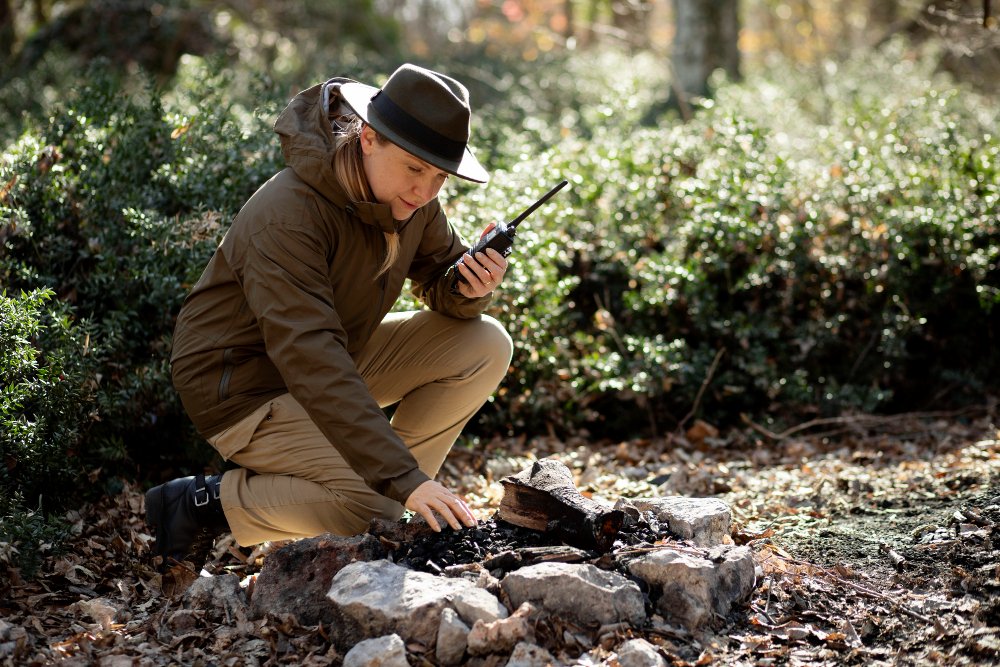
Long-range walkie-talkies are most useful when they combine durable construction, dependable coverage, clear audio, and features suited to your environment.
The right model is not necessarily the one with the longest feature list. Start with how you plan to use it. Outdoor work, events, travel, security, and emergency communication may each require different priorities, but a reliable walkie-talkie should withstand regular handling and changing conditions. Water resistance, impact protection, battery life, and an easy-to-use design can matter as much as advertised range.
Connection reliability is also essential. Conventional radios may lose contact when terrain, buildings, or distance obstruct the signal, while cellular Push-to-Talk models can extend communication through available mobile networks. Clear voice transmission, loud speakers, and noise reduction help users understand one another in busy or windy settings—similar to the focus on clear audio found in this Monoprice 110010 review. The sections below explain the features to consider when choosing long-range walkie-talkies.
How Push-to-Talk Over Cellular Extends Walkie-Talkie Range
Long-range walkie-talkies that use Push-to-Talk Over Cellular (PoC) are not limited to the short distances of traditional two-way radios. Instead of relying solely on local radio frequencies, PoC devices use available cellular networks to connect users in different locations. This can support communication across much greater distances, provided compatible network coverage is available.
Because range depends on cellular availability rather than a direct radio-to-radio signal, PoC walkie-talkies are useful for teams working across cities, regions, or large properties. They offer broader coverage than conventional radios, but “unlimited distance” should be understood as network-dependent rather than guaranteed everywhere.
Nationwide Coverage Through Cellular Networks
Long-range walkie-talkies that use Push-to-Talk Over Cellular (PoC) technology connect through cellular data networks instead of relying only on radio towers. This can extend communication across cities, states, and, where supported by the service provider, the country.
Coverage depends on the carrier’s network, local terrain, building conditions, and plan availability, so nationwide service does not mean coverage everywhere. Before choosing a PoC walkie-talkie system, confirm which networks it uses and whether its coverage matches the areas where your team works.
How Cellular Networks Extend Walkie-Talkie Range
Push-to-talk over cellular (PoC) radios do not rely solely on nearby radio towers or direct line of sight between users. Instead, they connect through cellular data networks and cloud-based communication services, allowing teams to communicate across much greater distances than traditional two-way radios. Coverage and performance still depend on the available network, so users should confirm service in their operating areas. Clear instructions and communication protocols also matter, as explained in this guide to effective team communication.
Private, Controlled Communication for Long-Range Walkie-Talkies
Push-to-talk over cellular (PoC) walkie-talkies can provide private group communication by using account-based access, user permissions, and managed talk groups. Unlike traditional radio channels that may be monitored by anyone with the correct frequency, these systems route conversations through a service platform and cellular data networks.
Privacy features vary by provider and plan. Before choosing a long-range walkie-talkie service, confirm whether it offers encrypted transmission, administrator controls, user authentication, and policies for storing or deleting audio and location data. A private talk group can limit who joins a conversation, but it should not automatically be described as anonymous or completely secure without documentation from the manufacturer or service provider.
How to Choose the Best Long-Range Walkie-Talkies for Your Budget
The best value comes from choosing a communication system that matches your coverage, reliability, privacy, and operating-cost needs. Push-to-talk over cellular (PoC) radios can provide nationwide communication through cellular networks rather than relying solely on conventional radio range, but service availability depends on network coverage and an active plan.
- Coverage: Check whether the provider supports the regions where your team operates, including rural or remote areas.
- Reliability: Look for network redundancy, dependable dispatch features, and a battery that can support a full workday.
- Privacy: Review the provider’s encryption, account controls, and data-retention policies instead of assuming every PoC system is fully private.
- Total cost: Compare the radio price with activation fees, monthly service charges, accessories, warranties, and replacement batteries.
- Scalability: Choose a system that makes it easy to add users, organize groups, and manage permissions as your team grows.
For businesses and teams that need communication beyond traditional radio range, a cloud-based PoC system may offer better value than buying higher-powered conventional radios. Compare the coverage map, service terms, and required features before purchasing to ensure the system fits your location and budget.